
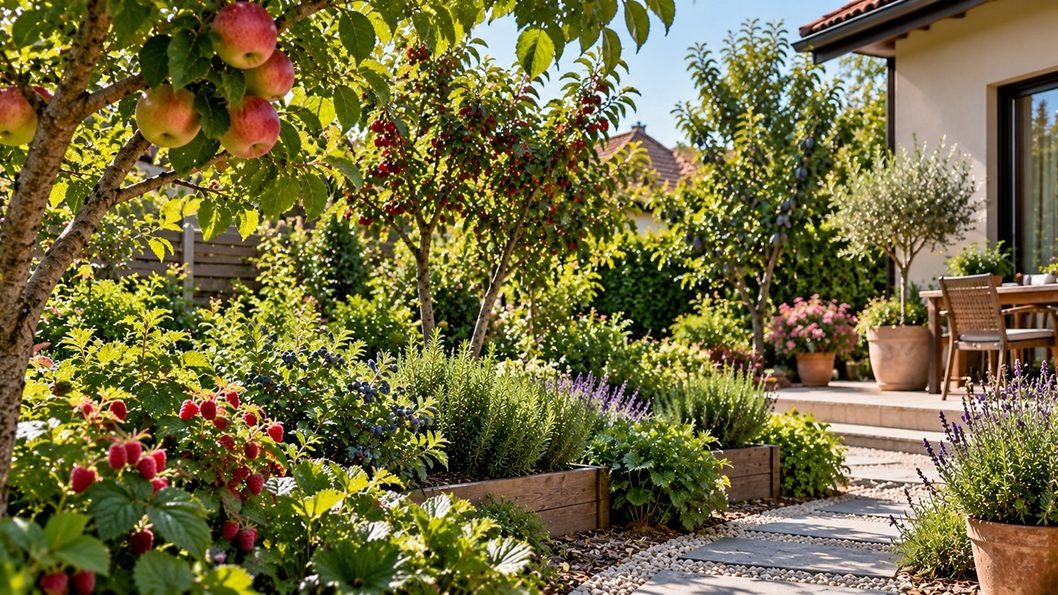

You don’t need a large yard or a spacious orchard to grow your own fruit. Even a small garden can become a source of fresh apples, pears, raspberries, strawberries and other delicious fruit, as long as the plants are carefully chosen and properly arranged. Modern fruit tree varieties, compact bushes and the option of growing in larger pots make it possible to use the space far better than it first appears.
Besides the pleasure of picking fruit from your own garden, growing fruit has many practical advantages. You control how the plants are cared for, reduce the need for chemical treatments and enjoy fruit picked at the moment it is fully ripe. A well-planned combination of fruit trees and berries can also be very decorative, because the plants change their look through the year, from spring blossom to autumn leaf color.
Which fruit trees are the best choice for a small garden?
When planning a small garden, the most important thing is to think about the size the plants will reach in a few years, not just how they look when you buy them. A young apple or pear sapling takes up little room, but its crown can become much wider over time. That is why trees grafted onto low-vigor rootstocks are especially interesting for limited spaces, as are varieties that tolerate regular shaping and pruning.
Apples and pears are among the most practical choices for smaller gardens. When grafted onto suitable rootstocks, they can be kept compact, which makes harvesting and care easier. Columnar apple trees are especially interesting, as their narrow crown allows planting in places where a classic fruit tree wouldn’t fit. Still, keep in mind that the final size of the plant depends on the variety, the rootstock and growing conditions.
Sour cherries also deserve attention, especially because the crown can be kept relatively low and because of their varied use in the household. The fruit can be eaten fresh, frozen or used to make juices, jams and cakes. For sunny, sheltered spots, figs can also be an interesting choice, especially compact varieties that can be grown as larger shrubs.
Before buying saplings, it is useful to check the pollination requirements too. Some fruit trees can bear fruit without another variety nearby, while others need a suitable pollinator that blooms at the same time. This is especially important in small gardens, where there is often not enough room to plant several trees of the same fruit species.
Berries give a rich harvest in a small space
While fruit trees need several years to develop a crown and reach full yield, many kinds of berries can start bearing much earlier. Their added advantage is that they can be planted along a fence, along garden paths or in separate beds, without taking up the central part of the yard.
Raspberries are among the most popular choices, mainly because of their aromatic fruit and because they are relatively easy to grow at home. Everbearing varieties, which fruit on one-year-old canes, usually in the second half of summer and in autumn, are especially interesting for small gardens. Raspberries need enough light, regular watering and suitable support, and their growth should be controlled, since some varieties spread through underground shoots.
Currants and gooseberries are an excellent choice for those who want productive yet decorative bushes. Red, white and black currants give small fruit with a distinctive taste, rich in vitamins and other beneficial plant compounds. They do well in places with plenty of light, but many varieties also tolerate partial shade, which makes them suitable for different parts of the yard.
Blackberries are also rewarding to grow, especially thornless varieties that make picking easier. Their long canes can be trained along a wire support or fence, which saves space and makes the plants easier to maintain. Still, don’t underestimate their vigor, as even thornless blackberries need regular pruning.
Blueberries and strawberries can thrive in pots too
A lack of free space doesn’t have to be an obstacle to growing fruit. Terraces, paved parts of the yard and sunny balconies can be turned into small edible gardens with the right containers.
Strawberries are probably the simplest example of this kind of growing. They can be planted in planters, larger pots and raised beds, and varieties that bear fruit over a longer part of the season are especially interesting. It is important to provide quality substrate, enough sunlight and even watering, because the soil in containers dries out much faster than in the garden on hot days.
Blueberries require a somewhat more careful approach, mainly because of their specific soil needs. Unlike most other fruit species, they grow best in a distinctly acidic environment, generally at a pH between 4.5 and 5.5. If the soil in your garden isn’t suitable, growing in large pots with a dedicated acidic substrate is often the more practical solution. Blueberries also need even moisture, with good drainage so that water doesn’t stay around the roots.
Proper planting plans matter more than garden size
A common mistake when arranging a small garden is planting too many plants too close together. At first such a layout can look attractive, but after a few years the plants shade each other, air circulation gets worse and picking becomes harder. Crowded crowns and overly dense bushes can also create more favorable conditions for the development of certain fungal diseases.
That is why it helps to make a simple plan before buying saplings. Fruit trees should be arranged so that their future crowns don’t block paths or shade smaller plants, while berries can be placed along the edges of the garden or in separate rows.
When choosing plants, pay special attention to their final dimensions, resistance to the local climate and care requirements. Various kinds of fruit trees and bush fruit can be found in the range of saplings for gardens and orchards, which makes it easier to compare options and plan planting according to the available space.
A good layout can include one or two smaller fruit trees as central elements, a few currant or gooseberry bushes along the fence, a row of raspberries with suitable support, and strawberries on the sunny edges of the beds. This combination provides a varied harvest without needing a large number of plants.
How to ensure healthy plants and a good yield?
Even the best-chosen varieties won’t give the expected results without suitable growing conditions. Most fruit species need at least six hours of direct sunlight a day, although some berries can do well in places with a little less light. It is especially important to avoid spots where water stays for a long time after rain, because excess soil moisture can damage the roots.
Before planting, it is useful to improve the soil structure by adding ripe compost or other suitable organic matter. Mulching the area around the plants helps retain moisture, softens temperature changes in the soil and reduces weed growth. Shredded bark, straw or other organic materials can be used as mulch, according to the needs of the specific fruit species.
Regular watering is especially important during the first year after planting, as well as during flowering and while the fruit is forming and ripening. Instead of frequent shallow wetting of the soil, it is generally better to give enough water for it to reach the active root zone, taking into account the type of plant, the weather and the soil’s permeability.
Pruning is another important measure that is often neglected. For fruit trees, it keeps the desired crown shape and lets more light in, while for raspberries, blackberries and currants it is used to remove old or damaged canes and encourage new growth. The method and timing of pruning differ between species, so it helps to learn about each plant’s needs before starting the job.
How to have fresh fruit for as much of the year as possible?
One of the biggest advantages of varied planting is the chance to stretch the harvest period over several months. Instead of filling the space with plants that ripen at the same time, it is more practical to combine species and varieties with different ripening times.
Strawberries can provide the first fruit as early as late spring, followed by early raspberry varieties, currants and sour cherries. During summer, blueberries, blackberries and some fig varieties ripen, while later in the season you can pick autumn raspberries, apples and pears. The exact schedule depends on the variety, the weather and the local climate.
In this way even a limited space can provide varied fruit over a large part of the growing season. Surplus harvest can be frozen, dried or processed, extending the benefits of growing your own into the winter months.
A small garden can become a source of great joy
Growing fruit in a small garden is not an attempt to build a classic orchard on a few square meters, but a chance to use the available space in a smarter and more useful way. A few well-chosen plants can often give more satisfaction and better-quality fruit than a large number of saplings lacking light and room to develop.
Besides fresh fruit, such a garden brings other benefits. The blossoms of fruit trees and berry bushes attract pollinators, greenery makes the surroundings more pleasant, and daily care of the plants becomes an activity in which all family members can take part. It is especially valuable for children to learn about the natural process of how food is made, from the first flowers to ripe fruit.
With a careful choice of varieties, quality saplings and a basic understanding of what plants need, even the smallest garden can become a beautiful, functional and productive space in which the ornamental value of greenery is successfully combined with growing healthy, tasty food.